

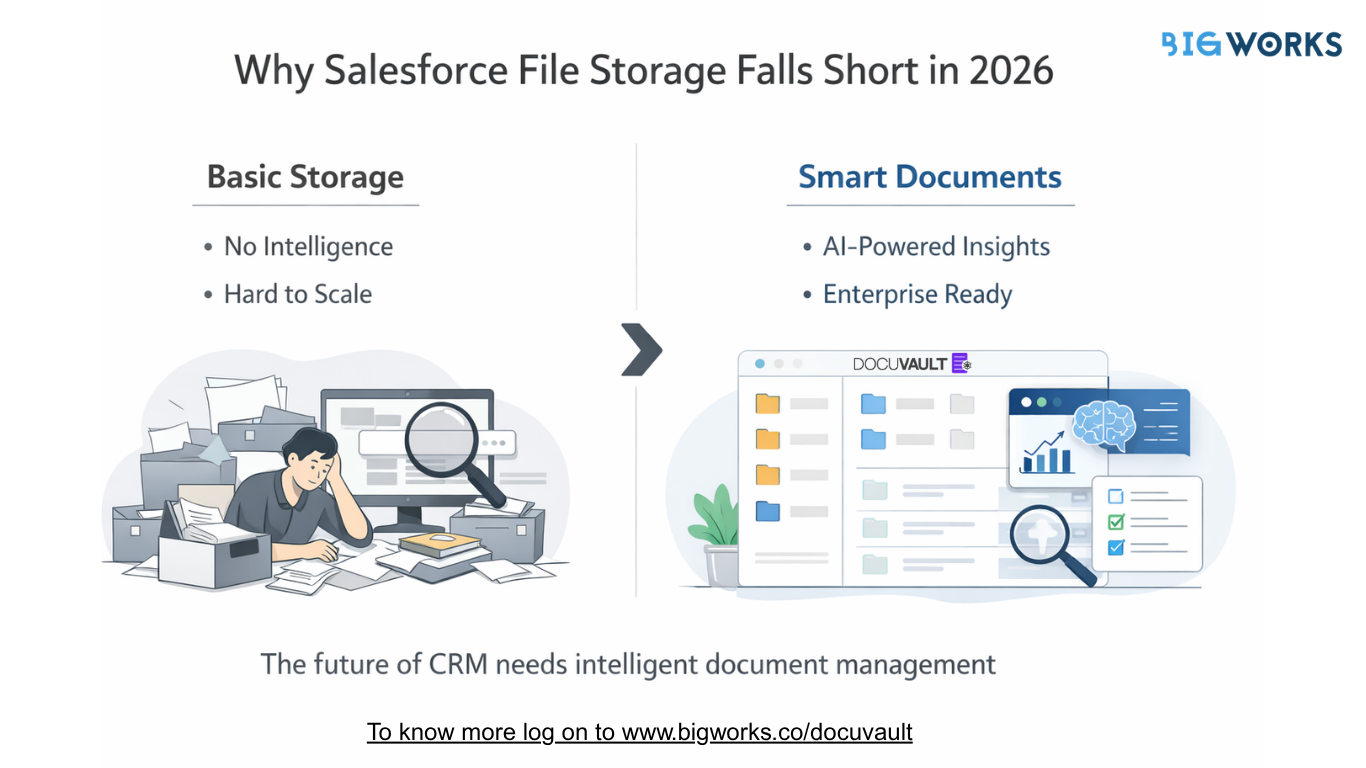

Why Salesforce’s Native File Storage Still Falls Short in 2026 And How DocuVault Fills the Gap
Introduction
Salesforce has evolved into one of the most powerful CRM platforms in the world. From sales automation to AI-powered insights through Einstein, it sits at the centre of many organisations’ digital operations. However, one area where Salesforce still shows limitations is document and file management.
Salesforce Files provides basic storage capabilities for attachments and documents, but as organisations scale, the limitations of native storage become increasingly visible. Companies managing large volumes of contracts, proposals, compliance records, and operational documents often find that basic file storage is not enough.
In 2026, the challenge is no longer simply storing documents. Businesses need intelligent, secure, and scalable document systems that integrate seamlessly with CRM workflows. This is where advanced solutions such as DocuVault help fill the gap.
The Growing Role of Documents in CRM Workflows
Documents are central to most customer-facing processes. Contracts close deals, onboarding documents activate accounts, and compliance records support regulatory requirements. In many industries, documents carry as much operational importance as CRM data itself.
According to IDC, unstructured data, including documents, represents over 80 per cent of enterprise information, much of which remains difficult to manage within traditional systems.
Source: https://www.idc.com/getdoc.jsp?containerId=US49686323
As document volumes increase, organisations require more than simple storage. They need structured access, automation, governance, and intelligent search.
Where Salesforce Native File Storage Falls Short
Salesforce Files was designed to attach documents to records and allow users to access them within the CRM. For small teams and lightweight use cases, this functionality can be sufficient. However, as document complexity grows, several limitations emerge.
Limited Large-Scale Document Management
Salesforce Files was not originally designed to act as a full document management system. Enterprises dealing with thousands or millions of files may struggle with organisation, scalability, and advanced document workflows.
Weak Document Intelligence
Native file storage does not provide advanced capabilities such as automated document classification, intelligent summarisation, or contextual analysis. As AI adoption accelerates, businesses increasingly expect their document systems to provide insights rather than simply store files.
Compliance and Governance Challenges
Industries such as finance, healthcare, and insurance require strict document governance. Version control, access permissions, audit trails, and lifecycle management are essential. Salesforce provides some security features, but its native file system is not purpose-built for complex compliance workflows.
Search and Retrieval Limitations
While Salesforce search is powerful for structured CRM data, locating the right document quickly can still be challenging when dealing with large file volumes or inconsistent naming conventions.
These limitations create operational inefficiencies that slow down sales cycles, support operations, and compliance processes.
The Business Impact of Document Inefficiency
Poor document management affects productivity across the organisation.
A McKinsey study found that employees spend nearly 20 per cent of their workweek searching for information or tracking down internal resources.
Source: https://www.mckinsey.com/business-functions/mckinsey-digital/our-insights/the-social-economy
When documents are difficult to locate or interpret, teams lose valuable time that could otherwise be spent on customer engagement and strategic work.
How DocuVault Fills the Gap
DocuVault addresses the limitations of Salesforce’s native file storage by transforming document management into a structured, scalable, and intelligent system within Salesforce.
Enterprise-Grade Document Storage
DocuVault enables organisations to store and manage large volumes of documents efficiently while keeping them fully integrated with Salesforce records.
This ensures that documents remain connected to accounts, opportunities, cases, and workflows.
Advanced Document Organisation
Instead of relying on manual file naming conventions, DocuVault supports structured organisation, automated tagging, and improved metadata management.
This dramatically improves searchability and accessibility.
AI-Powered Document Intelligence
Modern document management is moving toward intelligent workflows. DocuVault enables capabilities such as document summarisation and natural language query, allowing users to quickly extract insights from large documents.
This turns documents into actionable data rather than static files.
Compliance and Security
DocuVault provides enhanced document governance through structured permissions, audit tracking, and controlled access aligned with Salesforce security models.
This makes it easier for regulated industries to maintain compliance standards.
Why Salesforce-Native Document Platforms Matter
Organisations increasingly prefer solutions that extend Salesforce rather than operate outside it. When document management systems live outside CRM, teams must constantly switch between platforms, increasing friction and data inconsistency.
Salesforce-native tools like DocuVault ensure that documents remain within the CRM environment, preserving context and improving operational visibility.
This approach also supports emerging AI capabilities that rely on unified, structured data.
Preparing for the Next Phase of CRM Intelligence
As AI-driven workflows become standard, document systems must evolve beyond simple storage.
Gartner predicts that by 2027, more than half of enterprise AI initiatives will focus on extracting insights from unstructured data such as documents.
Source: https://www.gartner.com/en/newsroom/press-releases/2024
Organisations that modernise their document management today will be better positioned to leverage AI, automation, and advanced analytics in the coming years.
Conclusion
Salesforce remains one of the most powerful CRM platforms available, but its native file storage capabilities were never designed to handle the full complexity of enterprise document management.
As document volumes grow and AI-driven workflows become essential, businesses need more advanced solutions that combine storage, intelligence, governance, and integration.
DocuVault fills this gap by extending Salesforce with enterprise-grade document management capabilities that transform documents into searchable, structured, and intelligent assets.
For organisations preparing for the next phase of CRM evolution, modernising document management is not optional. It is foundational.