

Introduction
Salesforce has spent the past few years reshaping its platform around AI, automation, and modern workflow architecture. As part of this evolution, several legacy tools and experiences are being phased out or placed into maintenance mode. One of the changes impacting many CRM users is the end of active development and support for certain legacy email experiences associated with Salesforce’s Enhanced Email ecosystem.
While Enhanced Email introduced valuable capabilities when it launched, the modern CRM environment now demands deeper automation, smarter communication insights, and more integrated workflow execution.
For organizations relying on email as a primary customer engagement channel, this transition represents both a challenge and an opportunity.
What Enhanced Email Was Designed to Do
Enhanced Email was introduced to improve how Salesforce handled email records. Instead of treating emails as simple activity logs, Salesforce began storing them as EmailMessage objects, enabling more structured tracking and reporting. (simplysfdc.com)
This allowed teams to:
- Track sent and received emails as CRM records
- Generate reports on email activity
- Associate messages with leads, opportunities, and cases
When Enhanced Email is enabled, emails sent from Salesforce are logged as both EmailMessage records and related tasks, making them easier to track across workflows. (Salesforce)
For many organisations, this represented a significant improvement over basic email logging.
Why Salesforce Is Moving Beyond the Enhanced Email Experience
Salesforce’s product roadmap has increasingly focused on AI-first workflows and consolidated automation tools. In this context, some older email experiences are being phased out.
For example, Salesforce confirmed that support for the Enhanced Email Experience within Account Engagement will no longer receive updates, encouraging organisations to transition to newer email builders and automation tools. (Nebula Consulting)
This shift reflects a broader trend across the Salesforce platform. Several legacy features are being retired or replaced as Salesforce moves toward modern architecture built around Flow, Data Cloud, and AI automation. (Salesforce.com Partner)
The goal is to simplify the platform and reduce reliance on legacy systems that cannot support modern AI-driven workflows.
The Limitations of Enhanced Email in Modern CRM Operations
While Enhanced Email improved activity tracking, it still falls short in several areas that modern teams require.
Limited Email Workflow Automation
Enhanced Email primarily records email interactions. It does not offer sophisticated campaign orchestration, automated outreach sequences, or large-scale communication workflows.
Modern CRM communication requires automation that can trigger messages based on CRM events, deal stages, or behavioural signals.
Fragmented Communication Data
Emails often remain isolated within activity logs rather than becoming actionable insights. Sales and support teams frequently struggle to analyse communication patterns or measure engagement effectively.
Without structured communication intelligence, organisations cannot fully leverage CRM data to optimise outreach.
Weak Integration with Operational Workflows
Email is rarely an isolated activity. It is tied to proposals, approvals, project execution, and customer service processes.
Enhanced Email does not provide strong links between communication workflows and broader operational systems.
The Shift Toward CRM-Native Communication Platforms
As CRM workflows become more complex, businesses are moving toward integrated communication platforms that operate natively inside Salesforce.
These solutions go beyond simple email logging and enable organisations to:
- Run large-scale outreach campaigns
- Automate communication triggers
- track engagement analytics
- Integrate communication with CRM workflows
This shift mirrors broader changes in the Salesforce ecosystem as companies move away from legacy features toward more integrated tools.
What Native Alternatives Like Contacto Mean for Your Stack
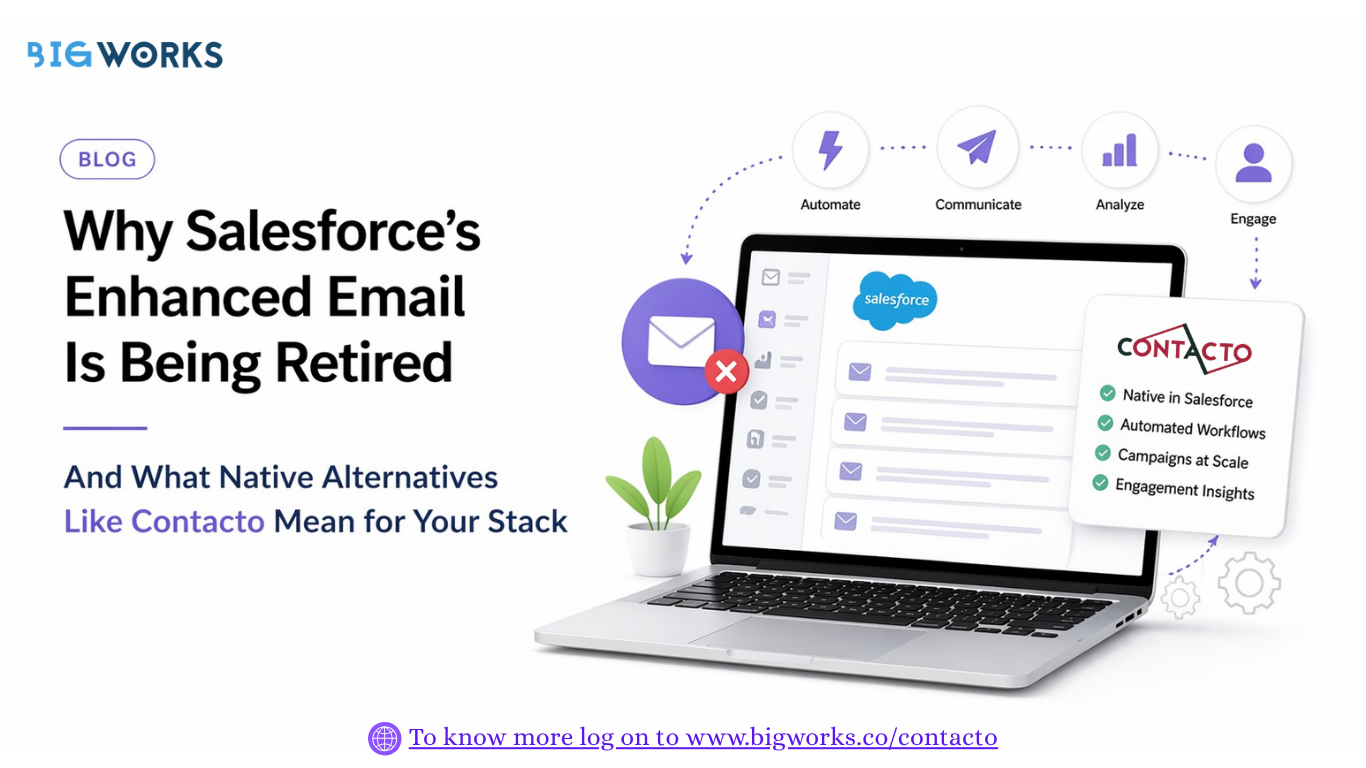
Contacto represents the new generation of CRM-native communication platforms designed to complement Salesforce rather than sit outside it.
Instead of treating email as a basic activity record, Contacto transforms it into a structured communication workflow.
Centralised CRM Communication
Emails are managed directly within Salesforce, ensuring that all customer communication remains tied to CRM records.
This preserves context across accounts, opportunities, and support cases.
Scalable Outreach Campaigns
Contacto allows teams to run large-scale outreach campaigns while maintaining personalisation through CRM data.
Sales teams can communicate with hundreds or thousands of prospects without losing visibility or control.
Integrated Workflow Automation
Communication becomes part of the broader CRM workflow.
Emails can be triggered by CRM events, deal stages, or operational milestones.
Better Visibility and Analytics
Instead of scattered email threads, organisations gain visibility into engagement patterns, response rates, and communication performance.
This makes outreach measurable and optimizable.
The Strategic Advantage of CRM-Native Communication
When communication platforms operate outside Salesforce, teams lose context and data consistency.
CRM-native tools solve this by embedding communication directly into the system where customer data already exists.
This approach offers several advantages:
- Reduced tool sprawl
- improved data consistency
- better workflow automation
- stronger security and compliance
As organisations scale their CRM operations, these benefits become increasingly important.
Conclusion
Salesforce’s move away from legacy email experiences reflects a broader shift toward modern, integrated CRM workflows.
Enhanced Email played an important role in improving activity tracking, but today’s businesses require more powerful communication systems that integrate deeply with automation, analytics, and operational processes.
Native platforms like Contacto represent the next phase of CRM communication, transforming email from a simple activity log into a scalable, measurable, and intelligent workflow component.
For organisations preparing their CRM stack for the future, upgrading the communication infrastructure is not just a technical decision. It is a strategic one.