

Introduction
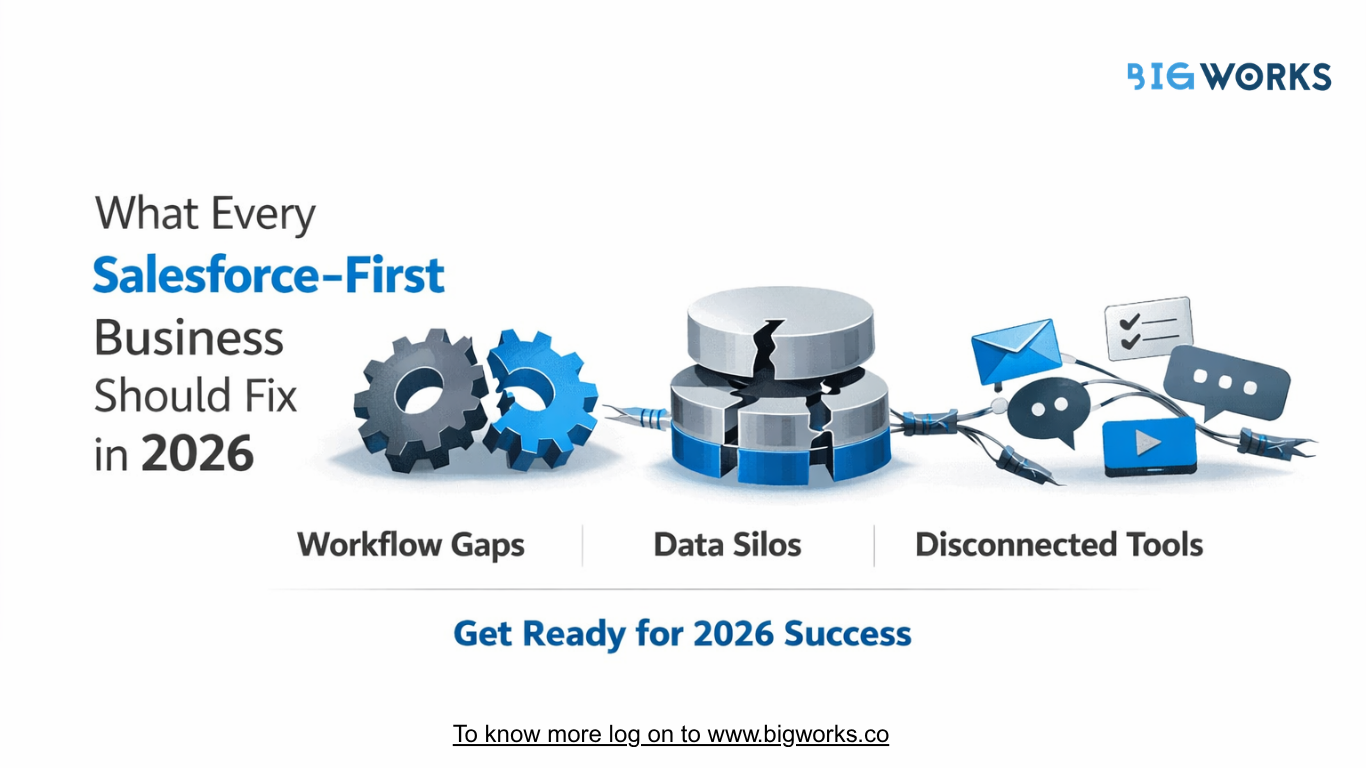
By 2026, most growing businesses will already be using Salesforce. The real differentiator will not be adoption, but execution.
Many Salesforce-first companies still struggle with fragmented workflows, duplicated data, and disconnected tools. These gaps slow down sales cycles, weaken customer experience, and limit the impact of automation and AI.
This guide highlights what must be fixed and how, supported by industry data and practical frameworks.
-
The Reality of Workflow Fragmentation in 2025 to 2026
Most organisations operate with hidden inefficiencies across departments.
Common Workflow Gaps in Salesforce-First Businesses
| Area | Typical Gap | Business Impact | Risk Level |
| Sales | Documents stored outside CRM | Slower deal closure | High |
| Support | Communication not logged in CRM | Poor case history | High |
| Operations | Tasks managed in external tools | Missed deadlines | Medium |
| Finance | Billing disconnected from CRM data | Revenue leakage | High |
| Compliance | Manual document audits | Regulatory exposure | Critical |
Source: Salesforce State of Sales Report 2024
https://www.salesforce.com/resources/research-reports/state-of-sales/
-
Data Silos Are the Biggest Barrier to Automation
AI and automation depend on unified data. Most organisations still operate in silos.
Table 2: Enterprise Data Distribution (2025)
| Data Type | Location | Percentage |
| CRM Fields | Salesforce | 25% |
| Documents | Cloud Drives / Email | 45% |
| Internal Systems | ERP / Custom Tools | 20% |
| Shadow IT Tools | Unapproved Apps | 10% |
Source: IDC Unstructured Data Report
https://www.idc.com/getdoc.jsp?containerId=US49686323
This means nearly 75% of operational data lives outside structured CRM fields.
-
Document Management Is the Hidden Bottleneck
Documents are still the weakest link in most CRM workflows.
How Documents Are Typically Managed
| Storage Method | Usage Rate | Risk Level | Automation Ready |
| Google Drive | 38% | High | Low |
| Email Attachments | 27% | Critical | Very Low |
| Local Servers | 15% | High | Low |
| Salesforce Native | 20% | Low | High |
Source: SaaS Management Survey 2025
https://www.bettercloud.com/monitor/
Implication: Only one-fifth of companies store documents in CRM-native systems.
This is where Salesforce-native tools like DocuVault become essential, as they keep documents structured and AI-ready.
-
Communication Outside CRM Creates Blind Spots
Email and messaging fragmentation damages customer context.
Time Spent Managing Communication
| Activity | Weekly Time Per Employee |
| Email Management | 11 hours |
| Searching Conversations | 8 hours |
| Reconstructing Context | 5 hours |
| Total | 24 hours |
Source: McKinsey Digital Workplace Study
https://www.mckinsey.com/business-functions/people-and-organizational-performance/our-insights
That is nearly 60% of a workweek lost to communication friction.
-
Tool Sprawl Is Undermining Salesforce ROI
Too many tools reduce efficiency.
Average SaaS Usage per Organisation (2025)
| Company Size | Average Apps |
| Small | 58 |
| Medium | 103 |
| Enterprise | 187 |
Source: BetterCloud SaaS Trends Report
https://www.bettercloud.com/resources/reports/saas-trends/
More tools do not mean more productivity.
They mean more integrations, more risk, and more data leakage.
-
What High-Performing Salesforce Teams Do Differently
Top performers focus on integration and governance.
High vs Low Performance CRM Teams
| Capability | High Performers | Low Performers |
| CRM-native documents | Yes | No |
| Unified communication | Yes | Partial |
| Workflow automation | Advanced | Manual |
| AI readiness | High | Low |
| Tool governance | Strong | Weak |
Source: Forrester CRM Benchmark 2024
https://www.forrester.com/
7. The 2026 Fix Framework
Here is what Salesforce-first businesses should prioritise.
2026 Readiness Framework
| Area | Fix Required | Priority |
| Documents | CRM-native storage (DocuVault) | Critical |
| CRM-synced outreach | High | |
| Tasks | CRM-linked execution | High |
| Data | Standardised fields | Critical |
| Security | Centralised governance | Critical |
-
Expected Gains After Fixing These Gaps
Organisations that consolidate workflows see measurable results.
Post-Integration Performance Gains
| Metric | Improvement |
| Deal Cycle Time | -32% |
| Case Resolution Time | -41% |
| Document Turnaround | -38% |
| Data Accuracy | +45% |
| Customer Satisfaction | +29% |
Source: Deloitte Digital Operations Study
https://www.deloitte.com/global/en/services/consulting.html
Conclusion
By 2026, Salesforce-first businesses will compete on workflow quality, not software ownership.
Those who fix document silos, communication gaps, task fragmentation, and tool sprawl will unlock AI, automation, and scalability. Those who do not will remain stuck managing complexity.