

Why Search Is Evolving from Keywords to Conversations
Introduction
Enterprise search has quietly undergone one of the biggest transformations in business technology. For years, finding information meant relying on exact keywords, folder names, or manually tagged documents. Employees often spend valuable time searching through shared drives, emails, and CRM records, hoping the right file will surface.
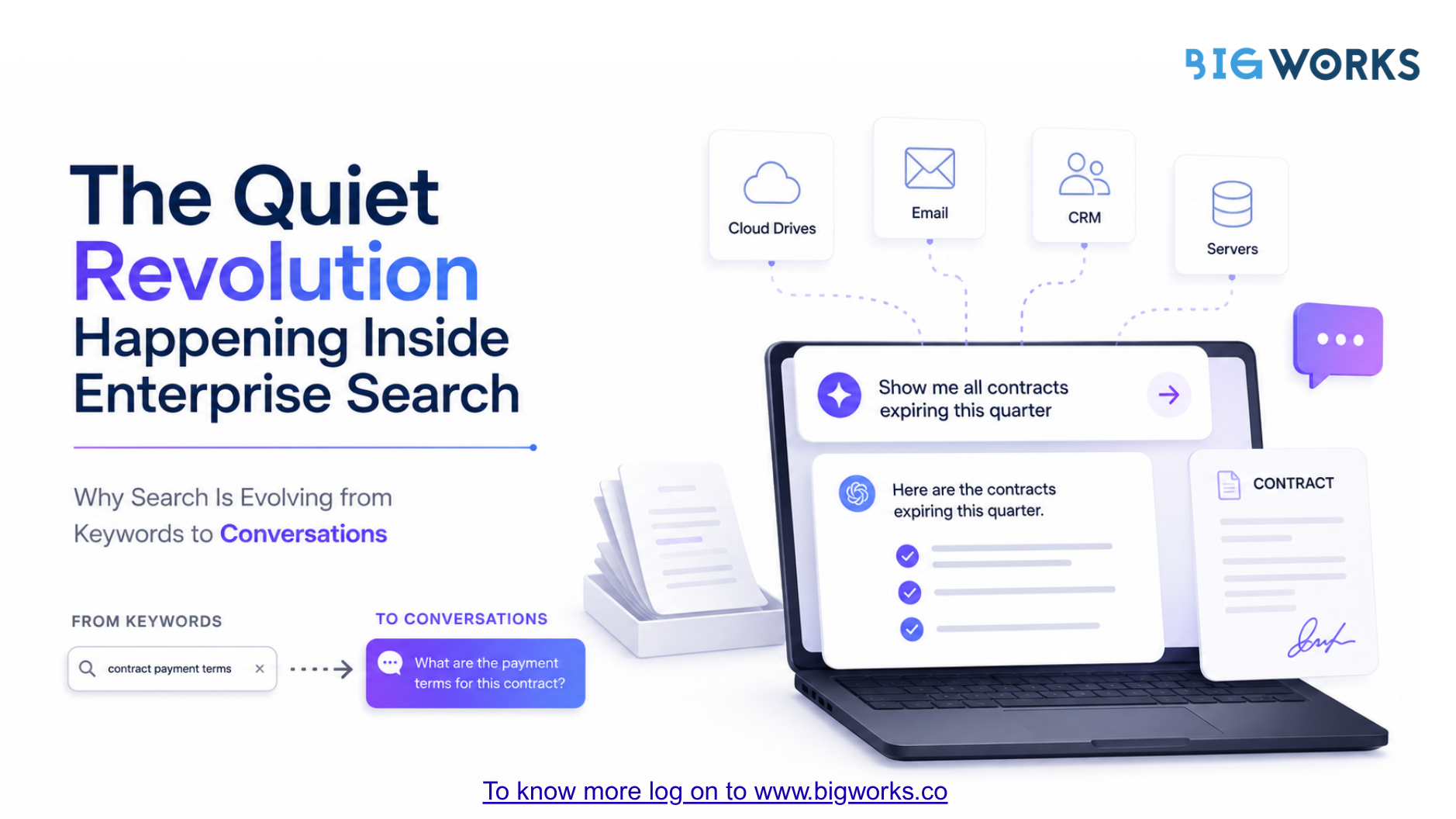
Today, that model is rapidly changing. Thanks to advances in generative AI and natural language processing, enterprise search is becoming conversational. Instead of remembering file names or keywords, users can simply ask questions like “Show me all contracts expiring this quarter” or “What were the payment terms agreed with this customer?” and receive contextual answers in seconds.
This shift is reshaping how businesses interact with information. Instead of acting as digital filing cabinets, document repositories are becoming intelligent knowledge hubs that improve productivity, customer service, and decision-making.
Why Traditional Enterprise Search Falls Short
Most enterprise search systems were built around metadata and keywords. While effective for small repositories, they struggle as organisations generate more documents across multiple platforms.
Common challenges include:
- Documents stored across cloud drives, email, CRM attachments, and local servers
- Inconsistent naming conventions
- Missing or inaccurate metadata
- Multiple versions of the same document
- Limited understanding of document context
According to McKinsey, employees spend up to 20% of their workweek searching for internal information or locating colleagues who can help with specific tasks.
Business Impact of Poor Enterprise Search
| Challenge | Business Impact |
|---|---|
| Time spent searching | Lower employee productivity |
| Duplicate documents | Increased storage costs |
| Missing information | Slower customer response times |
| Poor document visibility | Higher compliance risks |
| Knowledge silos | Reduced collaboration |
Source: McKinsey & Company – The Social Economy
https://www.mckinsey.com/capabilities/mckinsey-digital/our-insights/the-social-economy
From Keywords to Conversations
Modern AI is changing enterprise search fundamentally.
Rather than matching exact words, conversational search understands intent, context, and relationships between documents.
Instead of searching:
“contract ABC payment clause”
Employees can ask:
- Which customers have contracts expiring next month?
- What are the payment terms for this opportunity?
- Show me every NDA signed with this account.
- Summarise this proposal in five bullet points.
The AI retrieves relevant documents, understands their contents, and presents meaningful answers instead of a list of files.
This represents a shift from information retrieval to knowledge discovery.
Why This Matters for CRM
CRM platforms contain customer records, but much of an organisation’s knowledge still lives inside documents.
Examples include:
- Contracts
- Statements of Work
- Proposals
- Invoices
- Compliance certificates
- Customer onboarding documents
- Technical specifications
IDC estimates that approximately 90% of enterprise data is unstructured, with documents representing one of the largest categories.
Enterprise Data Distribution
|
Data Type |
Approximate Share |
| Structured CRM data |
10% |
| Unstructured documents |
90% |
Source: IDC – Worldwide Global DataSphere Forecast
https://www.idc.com/getdoc.jsp?containerId=US52076424
Without intelligent search, this information remains hidden despite being one of an organisation’s most valuable assets.
AI Search Is Becoming a Competitive Advantage
Organisations adopting conversational search report measurable improvements in efficiency.
Benefits of AI-Powered Enterprise Search
| Capability |
Traditional Search |
Conversational AI Search |
| Exact keyword matching |
✓ |
✓ |
| Understands intent |
✗ |
✓ |
| Summarises documents |
✗ |
✓ |
| Answers questions |
✗ |
✓ |
| Finds related information |
Limited |
✓ |
| Learns from context |
✗ |
✓ |
Gartner predicts that by 2027, generative AI will become the primary interface for enterprise knowledge discovery, replacing traditional keyword search for many business use cases.
Source: Gartner
https://www.gartner.com/en/newsroom
Preparing for the Future
Enterprise search is no longer about finding files. It is about finding answers.
As AI transforms search from keyword matching to natural conversations, organizations have an opportunity to unlock knowledge that has long been hidden inside documents.
For businesses using Salesforce, intelligent document management is becoming an essential part of this transformation. By keeping documents structured, searchable, and connected to CRM records, solutions like DocuVault help organizations prepare for the next generation of enterprise search.
The future belongs to businesses that can turn information into insight, and insight into action.