

From managing customer records to reasoning over business data and taking action, the Salesforce and Anthropic partnership signals a new direction for enterprise software.
Introduction
For years, CRM platforms have been where businesses store customer information, track deals, manage sales pipelines, and monitor customer relationships. AI has gradually made these systems smarter, helping teams summarise information, predict outcomes, and automate repetitive tasks.
But the next shift could be much bigger.
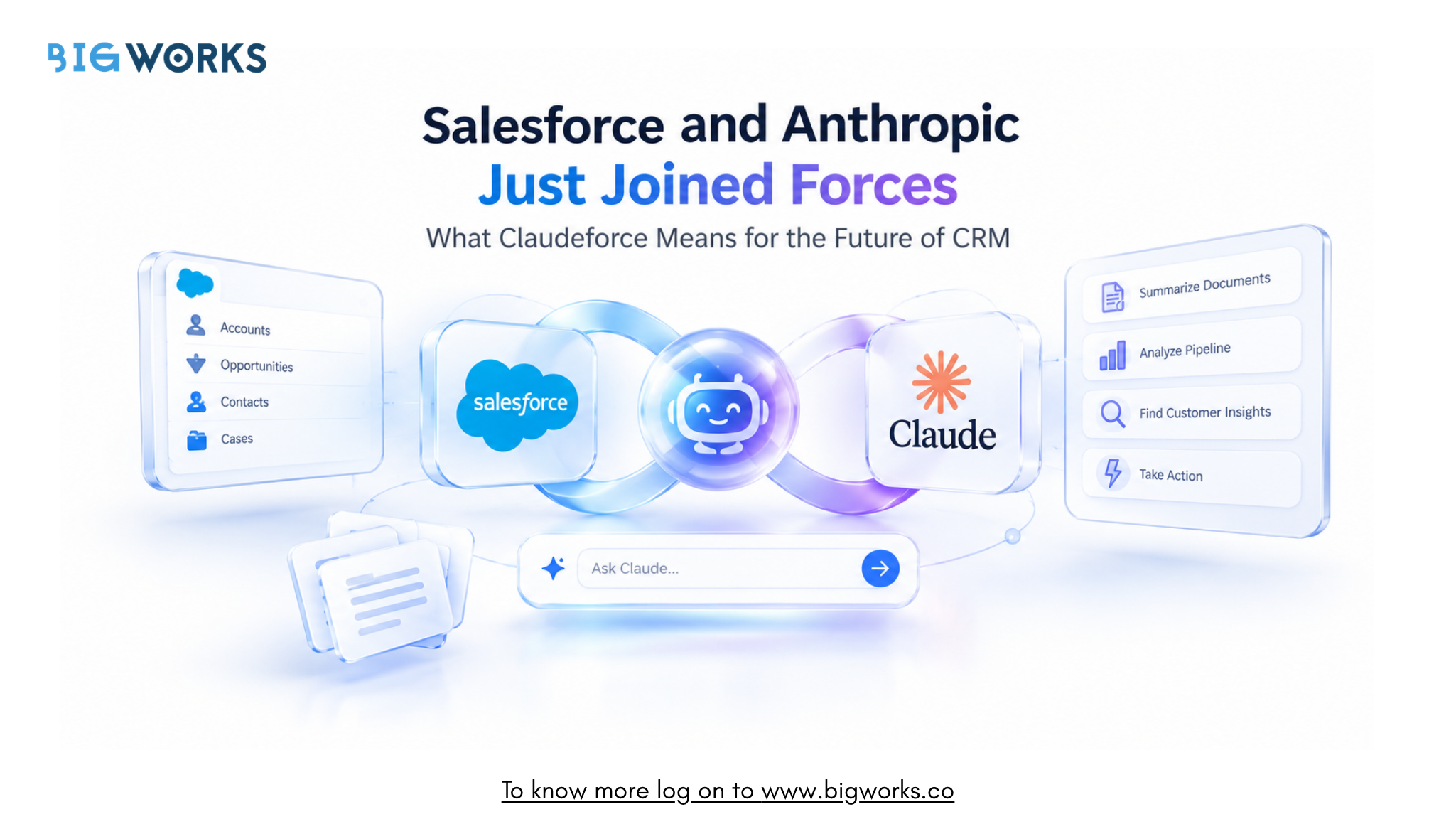
On August 26, 2026, Salesforce and Anthropic announced Claudeforce, an expanded partnership that brings Anthropic’s Claude AI models closer to Salesforce’s data, workflows, business logic, and governance. The goal is to let AI do more than answer questions about business operations. It can help teams take action within them.
The first major offering, Salesforce in Claude, brings sales workflows into Claude through a plugin with 37 prebuilt sales skills. These include meeting preparation, deal reviews, pipeline analysis, and CRM updates.
This raises an important question for businesses: what happens when the AI interface becomes as important as the software behind it?
1. What Is Claudeforce?
Claudeforce brings together two different strengths: Claude’s reasoning capabilities and Salesforce’s established business systems.
Claude can interpret requests, work through complex information, and coordinate multistep tasks. Salesforce provides the customer records, business rules, permissions, and workflows that give those actions their operational context.
The partnership has three major dimensions:
- Salesforce inside Claude: Sales teams can access relevant CRM context, review deals, prepare for meetings, and work with pipeline information without constantly switching into Salesforce.
- Claude inside Salesforce: Claude is available within Salesforce’s Agentforce ecosystem, including as a reasoning model for the Atlas Reasoning Engine and in Agentforce development experiences.
- Claude within Slack: The partnership extends into Slack, connecting conversations and team collaboration with business information and governed actions in Salesforce.
The larger idea is to make business software accessible through the interfaces where employees already work, rather than requiring every task to begin with navigating a separate application.
Source: Salesforce’s official ClaudeForce announcement
2. From CRM Data Entry to AI-Assisted Execution
One of the biggest sources of friction in sales is not necessarily selling. It is everything that surrounds selling.
A representative might spend hours gathering account history, checking Slack conversations, preparing for meetings, updating opportunity records, and writing follow-up notes. Each task is manageable on its own, but together they take time away from customers.
With Salesforce in Claude, these activities can be brought into a more conversational workflow.
| Traditional CRM workflow | AI-assisted workflow |
| Manually gather information before a meeting | Ask Claude to prepare a meeting brief using accessible business context |
| Review opportunity records one by one | Request a summary of pipeline health and deals that need attention |
| Update Salesforce after customer calls | Generate proposed record updates for review |
| Build a sales forecast from multiple reports | Analyse available pipeline data and prepare a forecast narrative |
| Search across conversations for deal context | Bring relevant Salesforce and connected Slack information into one workflow |
The difference is not simply that AI can write a better summary. It is that the AI can connect information gathering with the next step in the workflow.
For example, a sales representative could ask Claude to review a deal, identify missing stakeholders, prepare a close plan, and draft updates for Salesforce. The representative can then review the proposed changes before they are saved.
That turns AI from a passive assistant into a more active participant in day-to-day operations.
3. Why This Changes the Role of the CRM
Historically, enterprise applications have been built around their interfaces. Employees open the CRM, navigate to a record, find the relevant fields, and complete an action.
Claudeforce points towards a different model: the application becomes the system that powers the work, while the AI becomes one of the main ways employees interact with it.
This does not mean Salesforce becomes unnecessary. The underlying CRM still holds the records, rules, permissions, and workflows that businesses depend on. What changes is how employees access and use those capabilities.
Three implications stand out.
Less time navigating software
Employees may increasingly describe what they need in natural language instead of moving between tabs, dashboards, and records. This could reduce administrative friction, particularly for workflows that involve several connected steps.
More context-aware decisions
An AI assistant is more useful when it can work with current business information rather than relying only on what a user types into a prompt. Connecting AI to authorised CRM records and relevant team discussions can give its recommendations a stronger foundation.
A shift from features to outcomes
Businesses may increasingly evaluate CRM capabilities by the work they help complete. Instead of asking whether a system has a particular reporting feature, teams may ask whether they can identify at-risk deals, prepare a review, and complete the necessary follow-up faster.
The competitive question becomes less about the number of features a platform offers and more about how effectively it connects information, decisions, and actions.
4. The Real Challenge: AI Is Only as Useful as Its Business Context
More capable AI does not automatically mean better business outcomes.
A model can reason through a request, but it still needs accurate information, relevant context, and clear boundaries around what it can do. If customer records are outdated, documents are scattered, or important decisions exist only in disconnected systems, the AI may produce an incomplete picture.
For businesses, this makes data readiness a practical priority.
Before introducing AI into core workflows, organisations should ask:
- Is the underlying information reliable? Duplicate records, outdated fields, and inconsistent formats can undermine the quality of AI-generated insights.
- Can the AI access the right context? Customer records are only one part of a business relationship. Contracts, proposals, correspondence, and internal notes may also matter.
- Are actions governed appropriately? Teams need clear rules for which actions an AI can complete independently and which require human approval.
- Can employees verify the output? Users should be able to trace recommendations back to relevant business information and correct mistakes before they affect customers or operations.
The lesson is straightforward: connecting an AI model to a CRM is a technical milestone. Making that connection dependable enough for everyday business use is an operational challenge.
5. Security and Governance Must Keep Pace With Automation
As AI moves from answering questions to updating records and initiating workflows, governance becomes more important.
Salesforce says that Salesforce in Claude uses existing Salesforce authentication, permissions, and business rules to govern access and actions. The partnership is designed to let employees work with business information according to their authorised access.
That is an important foundation, but businesses should still assess how a deployment fits their own security and compliance requirements.
Practical questions include:
- Which employees and teams can connect the AI to Salesforce?
- Which records and fields can it read or modify?
- Are consequential updates reviewed before they are committed?
- How are actions logged, audited, and investigated if something goes wrong?
- What policies govern sensitive customer information and connected systems?
These questions matter because AI introduces a new way to interact with existing business capabilities. The controls that govern the underlying systems must remain effective even when the user is an AI assistant acting on a person’s request.
The objective should not be to automate every possible action. It should be to automate appropriate actions while preserving accountability for important decisions.
6. What This Means for Document Management and Enterprise Workflows
Customer relationships rarely live entirely inside CRM fields.
A sales opportunity may depend on a proposal, a signed agreement, a statement of work, a compliance document, or a long email thread. A service issue may require reviewing technical documentation and previous correspondence. These documents often contain information that influences the next business decision.
This is where the broader enterprise workflow becomes important.
If AI is expected to help employees move from a question to a decision and then to an action, organisations need to make the information behind those decisions accessible, organised, and governed.
Document management is therefore not separate from the AI conversation. It is part of the foundation that makes AI-assisted work useful.
For Salesforce-centric teams, DocuVault by Bigworks can support the document side of this challenge by helping businesses manage and work with documents connected to their Salesforce environment. Rather than treating files as disconnected attachments, organisations can make document organisation and access part of a more structured workflow.
The distinction is important: an AI model cannot reliably reason over information it cannot access, and access alone is not enough if the underlying documents are outdated, poorly organised, or difficult to verify.
As AI capabilities expand, businesses should look beyond the model itself and examine the systems that manage the information it depends on.
7. What Businesses Should Do Next
Companies do not need to redesign every process around AI immediately. A more practical approach is to start with workflows where the administrative burden is clear and the results are measurable.
Step 1: Identify a high-friction workflow. Choose a process such as meeting preparation, deal reviews, document retrieval, or post-call CRM updates.
Step 2: Audit the information involved. Check whether the required customer records, documents, and conversations are accurate, accessible, and appropriately permissioned.
Step 3: Define the limits of AI action. Separate tasks that can be automated from those that need review or approval.
Step 4: Pilot a specific use case. Measure time saved, data accuracy, user adoption, and the number of corrections required. Avoid judging success by the volume of AI-generated output alone.
Step 5: Expand only when the workflow proves reliable. Use the lessons from the pilot to improve data quality, governance, and process design before rolling the approach out more widely.
This approach helps businesses turn AI experimentation into a repeatable operational capability rather than another disconnected technology project.
Conclusion: The Future of CRM Is About Getting Work Done
Claudeforce is significant because it reflects a wider shift in enterprise software. AI is moving closer to the systems where business information lives, and those systems are becoming more accessible through conversational interfaces.
The potential benefit is not simply fewer clicks or faster summaries. It is a shorter path from business information to informed action.
But the value of this model will depend on more than the intelligence of the AI model. It will depend on reliable data, connected workflows, well-managed documents, appropriate permissions, and human oversight where it matters.
For businesses preparing for this shift, the question is no longer just how to add AI to the CRM. It is whether the information and processes around the CRM are ready for AI to use responsibly.
The organisations that get this foundation right will be better positioned to turn AI capability into measurable business value.