

Where AI Document Intelligence Should End, and Human Judgment Should Begin
Introduction
AI can now read, classify, summarise, and extract information from documents at a scale that would be impossible for a human team to match. Contracts can be analysed in seconds. Compliance documents can be scanned for missing information. Key dates, clauses, amounts, and obligations can be extracted automatically.
But there is an important distinction between understanding what a document says and deciding what the business should do about it.
That distinction is becoming increasingly important as companies move AI from experimentation into real business workflows. Recent research into document-heavy enterprise AI found that while many systems perform well in demonstrations, significantly fewer meet the requirements for sustained production use, including accuracy, reproducibility, attribution, and meaningful confidence signals. (papers.ssrn.com)
The question for businesses in 2026 is therefore not whether AI can process documents.
Which decisions should AI make, and which decisions should remain human?
AI Is Excellent at Extraction. Judgment Is Different.
Consider a contract.
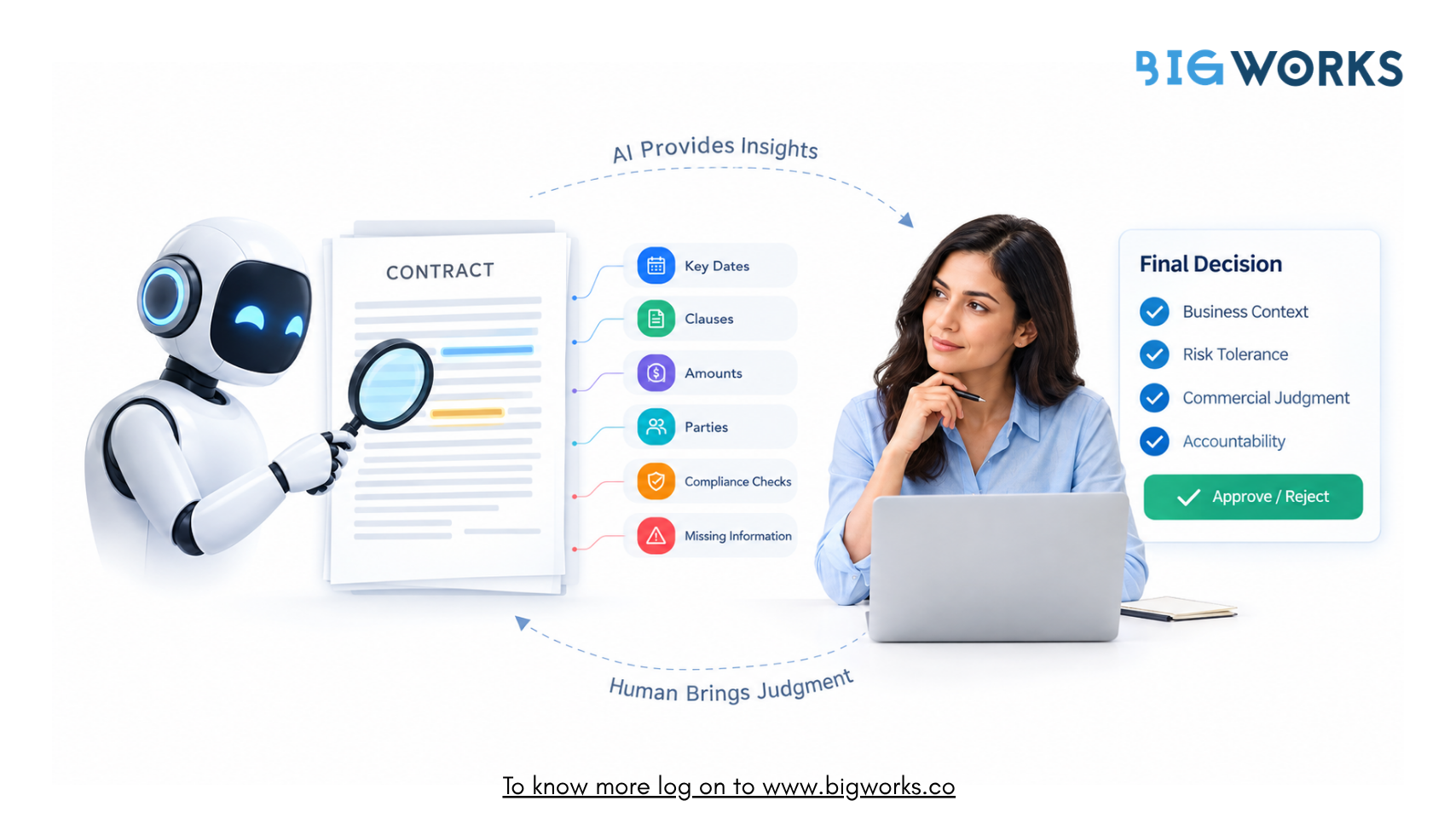
AI can identify:
- Contract start and expiry dates
- Payment terms
- Renewal clauses
- Liability limits
- Termination conditions
- Parties involved
- Missing information
That is extraction and analysis.
But consider a different question:
“Should we approve this contract?”
That requires business context, risk tolerance, commercial judgment, and accountability.
AI can provide the information needed to make the decision. It should not automatically become the decision maker.
NIST’s AI Risk Management Framework specifically recommends clearly defining human roles and responsibilities in human-AI systems, recognising that some AI applications require human oversight depending on the nature and consequences of the decision. (airc.nist.gov)
The Human-AI Boundary
A useful way to think about enterprise document workflows is to divide them into three layers.
|
Activity |
AI Role | Human Role |
|
Reading a document |
Extract information |
Review exceptions |
|
Summarising |
Generate summary |
Validate important conclusions |
|
Classification |
Categorise documents |
Handle ambiguous cases |
|
Compliance checks |
Identify potential issues | Determine regulatory response |
|
Contract analysis |
Flag unusual clauses |
Decide whether to accept risk |
|
Approval |
Recommend |
Make final decision |
| Sensitive business decision | Provide evidence |
Own the decision |
The objective is not maximum automation.
It is maximum useful automation with the right human checkpoints.
Where Humans Should Stay in the Loop
1. Contracts and Legal Documents
AI can identify unusual clauses, compare agreements against standard templates, and highlight important obligations.
But legal and commercial decisions should remain with qualified people.
A system can flag:
“This contract contains a liability clause that differs from the approved template.”
A legal or commercial team must decide:
“Is this difference acceptable?”
That distinction matters because a technically accurate extraction can still lead to a poor business decision if the surrounding context is misunderstood.
2. Compliance Decisions
Compliance is another area where AI can dramatically reduce manual work without eliminating human accountability.
AI can scan thousands of documents and flag:
- Missing information
- Expired certificates
- Non-standard clauses
- Potential policy violations
- Inconsistent records
But the final determination of whether a regulatory requirement has been met should remain subject to appropriate human oversight.
NIST recommends defining explicit responsibilities for humans who operate, oversee, and monitor AI systems, particularly when AI outputs influence consequential decisions. (airc.nist.gov)
3. High-Value Approvals
Not every document deserves the same level of review.
A useful approach is to let AI handle routine, low-risk decisions while escalating exceptions.
For example:
| Document Scenario | Recommended Approach |
| Standard NDA | AI processing with minimal review |
| Standard invoice | Automated extraction and validation |
| High-value contract | AI analysis + human approval |
| Non-standard legal clause | AI flag + legal review |
| Regulatory document | AI extraction + human sign-off |
| Sensitive customer decision | AI recommendation + human decision |
This creates a risk-based automation model rather than attempting to automate everything.
The Rise of Human-in-the-Loop Document AI
This approach is already emerging in production document workflows.
Research and industry implementations increasingly use confidence scores and exception routing to send only uncertain or high-risk information to human reviewers. One 2026 document AI implementation reported a 40% to 60% reduction in manual document review time by routing lower-confidence fields to human review instead of requiring people to check every field. (landing.ai)
That is the important shift.
Human-in-the-loop does not mean humans checking everything.
It means humans check what matters.
What This Means for Document Management
The rise of AI makes the underlying document management system more important, not less.
AI needs to know:
- Which document is the latest version
- Who has access to it
- Which customer or opportunity it belongs to
- Whether it is approved
- When it was created or modified
- What actions have already been taken
Without this context, even an advanced AI model can produce an answer based on the wrong document.
This is why document governance, version control, permissions, and auditability are becoming critical components of AI readiness.
For Salesforce organisations, DocuVault provides the document management foundation needed for this human-AI model.
By keeping documents connected to Salesforce records, DocuVault can help teams maintain the context around contracts, proposals, compliance files, and other business documents.
That creates a more controlled workflow:
Store → Analyse → Flag → Review → Approve → Audit
AI can handle the repetitive analysis and surface what requires attention. Humans remain responsible for decisions where judgment, accountability, or business context matters.
This is particularly important as AI becomes more deeply integrated into CRM workflows.
Salesforce itself emphasises human oversight and controlled handoffs in its approach to Agentforce, including guardrails for consequential decisions and mechanisms for escalating AI interactions to people. (salesforce.com)
The Goal Is Not Full Automation
There is a temptation to measure AI success by asking:
“How much human work did we eliminate?”
A better question is:
“How much unnecessary human work did we eliminate while keeping important decisions under human control?”
That distinction can dramatically change how businesses design AI workflows.
The best systems do not force employees to review everything. They use AI to identify what deserves their attention.
Conclusion
AI can read documents faster than humans. It can extract information, identify patterns, summarise complex content, and surface potential problems at extraordinary scale.
But reading is not the same as judgment.
As businesses deploy AI across contracts, compliance, approvals, and customer workflows, the winning approach will not be to remove humans from every process. It will be to design workflows where AI handles the volume and humans handle the consequences.
For Salesforce organisations, that requires more than an AI model. It requires secure, structured, contextual document management.
With DocuVault, businesses can build that foundation by keeping documents connected to the CRM while creating a workflow where AI can analyse information and humans can remain accountable for the decisions that matter.
The future of document management is not human versus AI. It is knowing exactly where each one works best.