

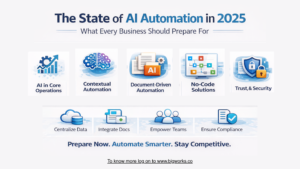
What Every Business Should Prepare For
Introduction
AI automation is becoming a baseline expectation across industries. Businesses are under pressure to move faster, reduce operational friction, and make smarter decisions with fewer resources. AI is increasingly the mechanism that enables this shift.
What has changed is not just the availability of AI, but how it is embedded into everyday business workflows. Automation is moving closer to where work actually happens, inside CRMs, document systems, and communication tools. For organisations that delay adoption, the risk is not disruption but irrelevance.
This blog outlines the key realities of AI automation in 2025 and what businesses must prepare for to stay competitive.
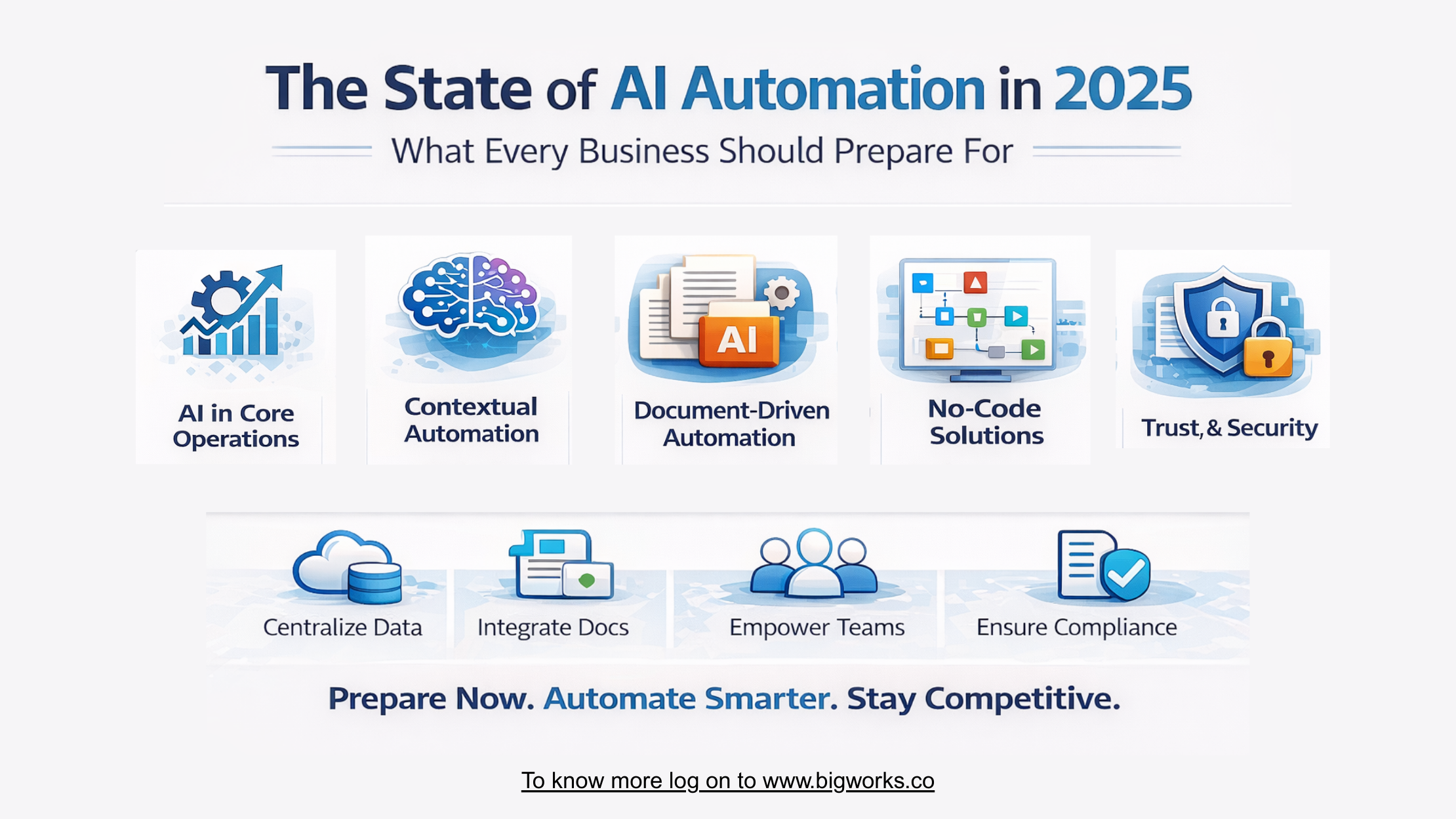
AI Automation Is Moving From Experiments to Core Operations
In earlier years, AI was often tested through pilots or innovation labs. In 2025, it is being deployed directly into revenue, service, and compliance workflows.
According to McKinsey, companies that scale AI into core operations see productivity improvements of 20 to 30 percent compared to those running isolated pilots (McKinsey Global Survey on AI, 2024).
This means AI is no longer optional or departmental. It is becoming foundational to how work is executed.
Automation Is Becoming Contextual, Not Generic
One of the biggest shifts in 2025 is that automation is no longer rule-based alone. AI systems now understand context.
Instead of triggering actions based only on static rules, AI analyses customer history, documents, activity patterns, and timing before recommending or executing actions.
In CRM environments like Salesforce, this means automation that adapts to the account, opportunity, or case rather than applying one-size-fits-all logic.
For document-heavy workflows, this is where Salesforce-native platforms like DocuVault play a key role by ensuring documents remain structured, searchable, and tied to CRM context. AI automation depends heavily on this level of data organisation.
Documents Are Becoming Automation Entry Points
Documents are one of the fastest-growing surfaces for AI automation.
Contracts, proposals, onboarding forms, and compliance files contain valuable operational signals. When documents are managed manually or stored externally, AI cannot effectively use them.
Gartner estimates that by 2026, over 60 percent of enterprise AI automation initiatives will start with document-centric workflows such as contract lifecycle management and compliance automation (Gartner, Future of Intelligent Automation, 2024).
Businesses preparing for 2025 must ensure their documents are not just stored, but integrated into core systems like Salesforce. DocuVault enables this by keeping documents native to CRM records, allowing AI-driven automation to operate reliably.
No-Code Automation Is Accelerating AI Adoption
AI automation in 2025 is increasingly no-code or low-code. This allows business teams to configure workflows without waiting for IT.
Sales, operations, finance, and HR teams are now directly building automations that previously required technical intervention. Gartner predicts that by 2026, 80 percent of technology solutions will be built by non-IT professionals (Gartner, Citizen Development Forecast, 2024).
This shift allows organisations to scale AI faster, but it also makes governance and platform choice more important than ever.
Trust, Governance, and Security Are Non-Negotiable
As AI automation expands, so does the need for strong governance.
Businesses must prepare for:
- Clear ownership of automated workflows
- Audit trails for AI-driven actions
- Role-based access controls
- Compliance with evolving data protection regulations
Platforms that operate natively within Salesforce inherit its enterprise-grade security, permissions, and compliance frameworks. This reduces risk while enabling faster automation adoption.
AI Is Augmenting Teams, Not Replacing Them
Despite widespread concern, AI automation in 2025 is largely assistive rather than autonomous.
AI supports teams by prioritising tasks, surfacing insights, and reducing repetitive work. Humans still make final decisions, especially in customer-facing and compliance-sensitive scenarios.
According to Salesforce research, 79 percent of employees say AI helps them focus on higher-value work rather than replacing their roles (Salesforce State of AI Report, 2024).
Businesses that frame AI as a productivity partner rather than a replacement tool see higher adoption and better outcomes.
What Businesses Should Do Now
To prepare for the state of AI automation in 2025, organisations should:
- Centralise data inside core systems like Salesforce
- Bring documents into structured, CRM-native environments
- Start with AI-assisted automation rather than full autonomy
- Choose no-code platforms that business teams can manage
- Establish governance before scaling automation
Preparation today determines competitiveness tomorrow.
Conclusion
AI automation in 2025 is defined by practicality, context, and scale. It is no longer about experimenting with emerging technology, but about embedding intelligence into everyday workflows.
Businesses that invest early in structured data, document automation, and Salesforce-native platforms will move faster, operate smarter, and respond better to customer expectations.
Those that delay will find themselves struggling to catch up in an environment where automation is no longer a differentiator, but a requirement.