
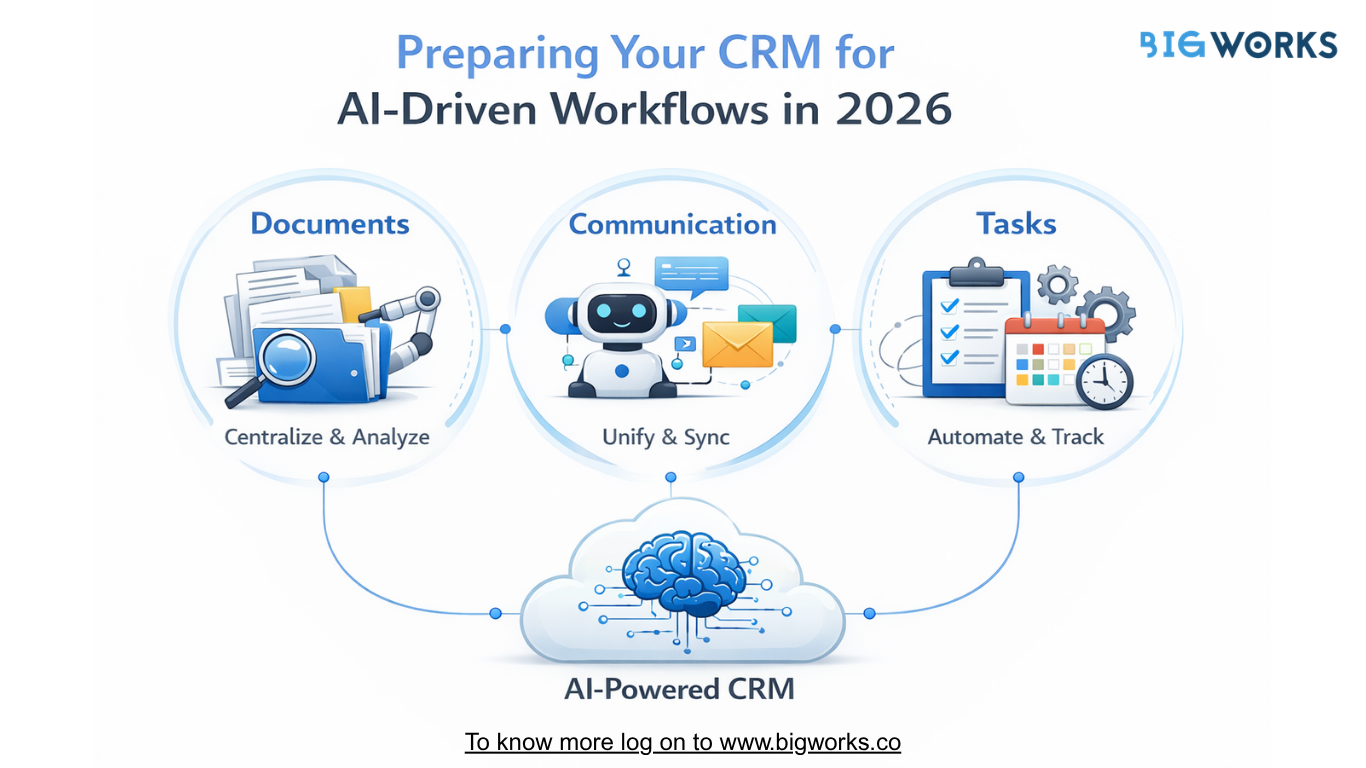

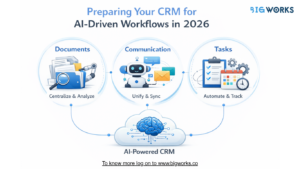
Documents, Communication, and Tasks as AI Entry Points
Introduction
AI adoption in CRM is moving from experimentation to execution. By 2026, businesses will no longer ask whether they should use AI in customer operations. The real question will be whether their CRM systems are prepared to support intelligent automation at scale.
Most AI initiatives fail not because of weak models, but because of fragmented data, disconnected workflows, and poor information structure. Documents live outside CRM, communication remains scattered across inboxes, and tasks are tracked in isolated systems. In such environments, AI cannot deliver meaningful results.
This guide outlines how organisations can prepare their CRM platforms for AI-driven workflows by strengthening three critical foundations: documents, communication, and task management.
-
Why CRM Readiness Determines AI Success
AI depends on context. Without unified, high-quality data, even advanced systems produce unreliable outcomes.
According to Gartner, 85% of AI projects fail due to poor data quality, lack of integration, and unclear business processes (Gartner AI Readiness Report, 2024).
CRM platforms like Salesforce already contain core customer data. However, much of the operational context still exists outside structured CRM fields. Preparing for AI requires closing this gap.
-
Documents as the First AI Entry Point
Documents are one of the richest sources of business intelligence. Contracts, proposals, onboarding forms, compliance files, and case documents contain insights that rarely exist in CRM fields.
When documents are stored externally, AI systems cannot access or analyze them effectively.
What Businesses Must Fix
- Centralise document storage inside CRM records
- Enable automated tagging and metadata extraction
- Maintain version control and audit trails
- Link documents to accounts, opportunities, and cases
Salesforce-native document management solutions like DocuVault enable organisations to structure document data and make it AI-ready without leaving the CRM ecosystem.
Business Impact
- Faster contract and proposal processing
- Improved compliance monitoring
- Better forecasting from historical documents
According to IDC, unstructured data, including documents, represents over 80% of enterprise information assets (IDC Data Growth Report, 2024).
-
Communication as a Real-Time Intelligence Layer
Emails, follow-ups, and customer conversations are continuous signals of intent and satisfaction. Yet in most organisations, communication data remains scattered across inboxes and third-party tools.
AI-driven CRMs require complete communication histories to generate accurate insights and recommendations.
What Businesses Must Fix
- Sync emails and outreach campaigns with CRM records
- Capture internal and external conversations centrally
- Apply sentiment and engagement analysis
- Enable searchable communication archives
When communication is connected to CRM data, AI can predict churn, identify upsell opportunities, and optimise response timing.
McKinsey reports that companies using data-driven personalisation in communication see up to 40% higher conversion rates (McKinsey Digital, 2024).
-
Tasks and Workflows as Execution Signals
Tasks represent intent. They show what teams plan to do and what actually gets done. In disconnected systems, task data becomes unreliable and invisible to AI.
For AI to optimise execution, task management must be embedded in CRM workflows.
What Businesses Must Fix
- Link tasks to customer records
- Automate task creation from CRM triggers
- Track dependencies and delays
- Monitor execution performance
CRM-integrated task systems like Workon allow businesses to convert sales commitments and service promises into visible, trackable execution workflows.
-
Build Unified Workflow Architecture
AI performs best in environments where documents, communication, and tasks interact seamlessly.
Target Architecture for 2026
| Layer | Role in AI Workflows | Example Capability |
| Documents | Knowledge base and evidence | AI search and classification |
| Communication | Behavioral and intent signals | Sentiment analysis |
| Tasks | Execution and performance data | Predictive scheduling |
| CRM Core | Customer context | Unified profiles |
This unified architecture allows AI to reason across multiple data types rather than operating in isolation.
-
Strengthen Data Governance Before Scaling AI
As AI automation expands, governance becomes critical.
Governance Requirements
- Role-based access controls
- Document-level permissions
- Audit logs for AI actions
- Compliance monitoring
- Data retention policies
Salesforce-native platforms inherit enterprise-grade security, reducing governance overhead while supporting automation.
-
Prepare Teams for AI-Augmented Work
Technology alone does not deliver transformation. Adoption depends on people.
Enablement Priorities
- Train teams using real CRM scenarios
- Explain how AI recommendations are generated
- Establish feedback loops
- Reward adoption and optimisation
According to PwC, organizations that invest in AI training are twice as likely to achieve positive ROI (PwC AI Impact Study, 2024).
-
Measure AI Readiness and Performance
Preparation must be measurable.
Key Readiness Indicators
|
Metric |
Target for 2026 |
| CRM Data Completeness |
Above 95% |
|
Document CRM Integration |
Above 90% |
| Communication Sync Rate |
Above 85% |
| Workflow Automation Ratio |
Above 60% |
| Manual Task Dependency |
Below 25% |
Tracking these indicators ensures that AI initiatives remain grounded in operational reality.
Conclusion
AI-driven workflows in 2026 will be built on foundations laid today. Organisations that structure documents, centralise communication, and integrate task execution into CRM systems will unlock reliable automation and predictive intelligence.
Preparing for AI is not about buying new tools. It is about making existing systems work together intelligently.
Businesses that invest in CRM readiness now will move faster, operate smarter, and compete more effectively in the next phase of digital transformation.